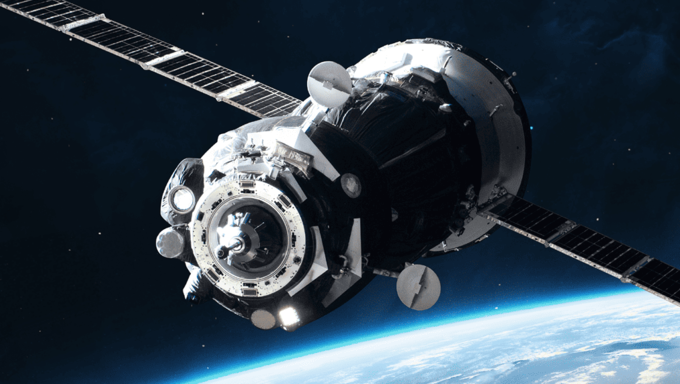
Fast Steering Mirrors Enabling Free-Space Optical Communication for LEO Satellites
High-Speed Laser Communication with Fast Steering Mirrors for Precise Beam Control
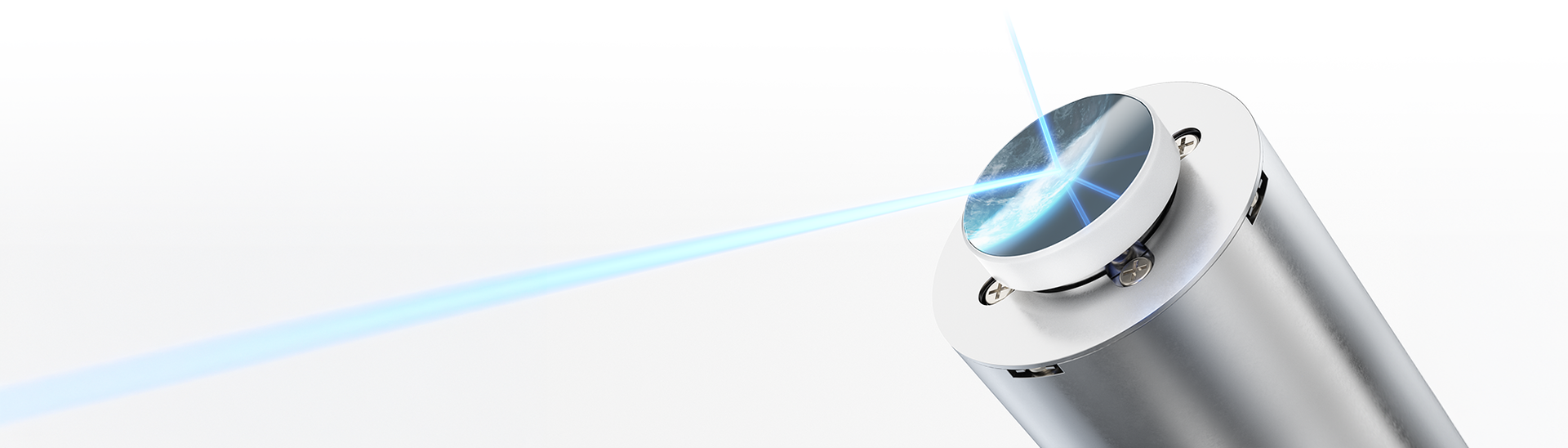
Free-Space Optical Communication (FSOC) in Low Earth Orbit (LEO): Enabling the Next Generation of Satellite Networks
- High-data-rate optical links for LEO constellations
- Precise beam steering for pointing, acquisition, and tracking
- Designed for scalable satellite deployment
Applications such as global internet coverage and Earth observation are driving the rapid growth of LEO satellite constellations. As these constellations scale in size and capability, traditional radio frequency communication can no longer keep pace with growing data volumes and performance expectations. The future of satellite networking demands high data rates, low latency, and secure optical links. FSOC meets these requirements by transmitting data through a narrow laser beam.
At the same time, maintaining optical links in LEO is extremely challenging. Satellites move at velocities of several kilometers per second while communicating across distances of hundreds to several thousand kilometers, leaving virtually no margin for error. Reliable laser communication depends on flawless pointing, acquisition, and tracking (PAT), requiring systems that react instantly and keep the beam precisely aligned throughout link acquisition and operation.
Expert Insights on Fast Steering Mirrors for Free-Space Optical Communication
Expert Insights on Fast Steering Mirrors for Free-Space Optical Communication
Our podcast explores FSOC in LEO, focusing on the challenges of pointing, acquisition, and tracking and the technologies that make optical links reliable.
To enable optical communication, LEO satellites are typically equipped with multiple optical terminals that can transmit and receive laser signals. This layout allows flexible connections to neighboring satellites and improves network reliability. Each optical terminal performs coarse and fine beam alignment to acquire and maintain the optical link, while continuously compensating for disturbances caused by motion and vibration. PI contributes fast steering mirrors that are especially well suited for these tasks, providing fast, precise, and compact beam control for stable optical links.
PI’s Fast Steering Mirrors for Free-Space Optical Communication (FSOC)
PI brings proven experience to free-space optical communication in LEO, with thousands of fast steering mirrors already deployed in LEO applications.
Depending on the system architecture and mission requirements, customized solutions derived from PI’s standard products can be successfully deployed. Learn in our >> use case how a fast steering mirror solution was designed to ensure stable optical links under real operating conditions.
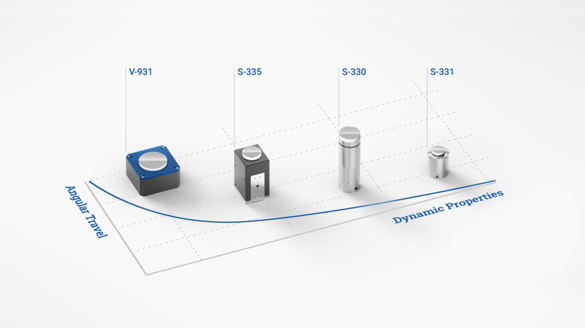
In practice, three fast steering mirror platforms from PI’s portfolio are most frequently deployed: >> V‑931, >> S‑335, and >> S‑330. Each of these solutions is designed for different combinations of dynamic performance and angular travel as can be seen in Figure 1. Thanks to PI’s customization capabilities, the boundaries between traditional products begin to blur. Rather than rigid categories, PI offers a continuous design space in which each solution can be tailored precisely to the requirements of the mission.
Free-space optical communication extends beyond satellite to satellite links and is used in a range of optical communication scenarios, including satellite to ground communication. Although system requirements vary, all applications share the same fundamental challenges: motion, dynamics, and precision. PI addresses these challenges with a wide range of high performance motion and positioning solutions, supporting optical communication both in space and on the ground.